Straight-through processing (STP) brokers are a big deal in the CFD world. If you care about how your trades get filled, who’s on the other side, and what you’re really paying, STP isn’t just a buzzword—it shapes everything from how your orders are routed to what kind of trade data you see afterwards.
This article breaks down how STP CFD brokers work, how they’re different from market makers and ECNs, and what actually happens behind the scenes when you place a trade. You’ll also get practical tips on what to look for—like key metrics and checks—when sizing up an STP broker.
This is written for traders who already know the basics like spread, slippage, VWAP/TWAP, and latency, but want a clear, no-nonsense guide to STP in CFDs. The goal is to give you the details you need to test a broker, run a pilot, and see for yourself if STP really delivers better results than other setups.
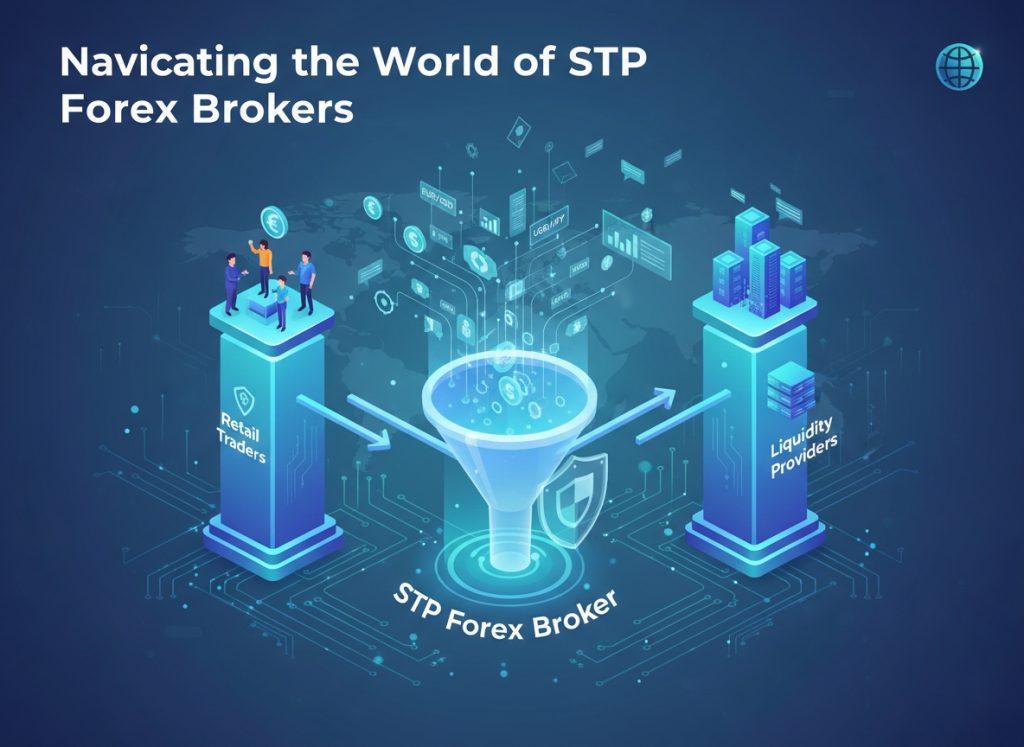
An STP CFD broker is a broker that routes client orders directly to external liquidity providers or market venues rather than filling trades from the broker’s own inventory. The broker’s role is routing and settlement facilitation; it does not, in principle, act as principal to the client on a trade-by-trade basis. In practice, STP covers a spectrum of implementations: truly agency routing into multiple independent providers, routing into a small panel of preferred counterparties, and proprietary consolidation where external quotes are used to generate a single feed but the broker still retains discretion over execution.
What makes an STP broker stand out in the CFD world? First, they separate quoting prices from taking the other side of your trades. Instead of acting as your direct counterparty, STP brokers send your orders out to outside liquidity providers—so your trades are usually filled by someone else, or matched transparently.
But remember, even though your order gets routed out, the CFD itself is still a contract issued by the broker or a clearing firm. That means you still need to look closely at both how well your trades are filled and what kind of counterparty risk you’re taking on with that broker.
STP differs from a pure ECN model in that STP is a routing paradigm rather than an exchange-like matching venue. It differs from market-maker models because execution is intended to occur off the broker’s balance sheet. However, the practical boundary between models is porous: STP brokers may route most flow outward but still internalize some orders during contingencies or route to affiliated liquidity providers that function effectively as principal counterparties.
Operationally, an STP CFD broker typically offers aggregated pricing derived from provider feeds, an execution waterfall that defines routing priorities, APIs or front-end order entry, and clearing relationships that determine how settlement and margin are handled. For traders, the critical questions are whether routing is genuinely agency, whether the broker discloses route-level fills, and how the broker hedges the residual exposure from client flow.
I recommend that you visit Forex Brokers Online to find a good STP CFD forex broker. They review brokers regulated all over the world.
Comparing STP to the alternatives clarifies tradeoffs and expected behaviours.
Market maker brokers provide two-sided quotes and often take the other side of client trades. This model guarantees immediate execution at quoted prices but creates potential conflicts of interest: the broker’s incentives to manage inventory and hedge can affect quotes and client outcomes. Market makers often internalize flow and hedge in external markets; the speed and quality of those hedges determine the material cost to the broker and indirectly to the client.
ECN models provide a genuinely centralized or distributed order book with deterministic matching rules, enabling participants to post and take liquidity directly. ECNs are venue-centric; participants see depth and priority and execution follows defined price-time rules. For traders whose strategies rely on posting or precise queue dynamics, ECN access is preferred.
STP is an intermediary model. It can, and often does, route to ECNs, exchanges, banks or market makers. The promise of STP is agency routing—reduced principal conflict and potentially better access to the best available price. The reality depends on routing policies, provider diversity and whether the broker receives payments or incentives that bias routing.
Three practical differences matter: visibility, determinism and incentive alignment. Visibility covers per-trade venue IDs and timestamps; determinism refers to whether matches follow clear rules or dealer discretion; incentive alignment covers whether the broker’s revenue model (commissions, referral fees, spread retention) biases routing. STP brokers that publish venue-level execution reports and provide router controls deliver closer to agency behaviour; those that do not can be operationally indistinguishable from slimmed-down market makers.
Order routing in STP implementations is an operational pipeline that transforms client orders into executed trades with external counterparties. The sequence typically comprises front-end acceptance, pre-trade validation, router decision logic, submission to external providers, and post-trade reconciliation. Each stage introduces latency, potential failure modes, and distortions that affect net execution.
Pre-trade validation is straightforward: the broker checks margin availability, client permissions, order syntax and risk thresholds. Where the client uses APIs, the broker enforces message limits and throttles to protect infrastructure. The router then evaluates available quotes, provider capacity, historical fill behaviour and cost, and applies execution rules. Routing can be static—sending certain instruments to fixed counterparties—or dynamic—selecting routes by live quote quality, depth and latency.
The router’s decision criteria typically include best price, available size, provider reliability and counterparty credit settings. For a marketable order, the router may sweep across multiple providers until filled, or it may prefer a single provider expected to offer best execution. For limit orders, the router can post to a provider’s book or retain the order for internal crossing. Where midpoint or price improvement logic exists, the router may seek to improve the published bid/ask under provider-specific rules.
Clearing and settlement introduce another layer. In exchange-based underlying markets, clearing occurs through central counterparties, reducing bilateral credit risk. In OTC-underpinned CFDs—particularly single-stock CFDs referencing fragmented underlying liquidity—execution may be hedged bilaterally, and residual counterparty exposure remains with the broker or its hedging counterpart. Some STP brokers arrange clearing via third-party clearing members which assume settlement obligations; others hedge net exposure directly and retain clearing relationships internally.
Execution waterfall disclosure is a practical marker of transparency. A waterfall describes routing priority: internal book, preferred external providers, alternate external providers, affiliates and fallback market makers. Traders should obtain the waterfall or request the broker’s routing policy. When a broker routes preferentially to affiliates or to providers paying higher referral fees, routing choices may trade off best execution for commercial revenue.
Finally, pre- and post-trade telemetry is vital. The router should log submission timestamps, matched provider, executed price, and any partial fills or reroutes. Robust STP implementations provide a reconciliation file that maps client orders to provider fills, enabling independent transaction cost analysis (TCA).
Execution quality for STP CFD brokers must be assessed empirically. Candidate metrics include effective spread, implementation shortfall, fill probability for limit orders, depth cost by size bucket, latency from order submission to execution, and frequency of rejects, requotes and partial fills.
Effective spread captures how near executed prices are to the midpoint at submission. Implementation shortfall measures realized execution relative to the decision or arrival price and is the most relevant benchmark for larger orders. Fill probability for passive orders determines whether a posting strategy is viable. Depth cost quantifies the price movement incurred when executing marketable orders larger than displayed size.
Common failure modes that undermine STP value include stale or delayed provider feeds, routing to illiquid counterparties, inter-provider latency mismatches that cause partial fills, and undisclosed internalization where fills are handled by an affiliated liquidity source without clear disclosure. Requotes arise when provider quotes change between receipt and execution; excessive requotes are a signal of fragile routing.
Another failure mode is hedge slippage: because CFDs are derivative instruments, an STP broker typically hedges net client exposure in underlying markets. If the broker hedges poorly—slowly, in large blocks, or against illiquid instruments—client fills can diverge from the broker’s hedge execution price. A transparent broker provides venue IDs and timestamps for both client fills and hedge trades, enabling measurement of the hedge slippage component.
Assessment requires transaction-level data. Traders should request per-trade execution reports that include a unique order ID, time of client order receipt, routing decisions, venue/provider IDs, executed price and size, and timestamps of any hedges. Without those fields, TCA is incomplete and claims of STP routing cannot be validated.
STP models separate explicit execution fees from implicit costs, yet the net economic outcome depends on both. Explicit costs include per-trade commissions, per-lot fees, data and connectivity fees, and clearing charges. Implicit costs comprise realized spread, depth cost, market impact, and hedge slippage.
Some STP brokers publish raw aggregated provider spreads and add a per-trade commission. Others embed a markup in the published price and charge no commission. Maker-taker or rebate systems are less common in retail CFD markets but occur in institutional contexts. Where brokers receive referral fees or pass-through rebates from providers, those arrangements must be disclosed because they influence routing priorities.
A thorough economic analysis uses total round-trip cost: effective spread plus commissions plus expected hedge slippage plus financing for the intended holding period. For example, a tight displayed spread offset by a high commission or substantial hedge slippage can be worse for the trader than a wider spread with predictable market maker pricing.
Financing and overnight swap rates remain relevant. STP execution affects trade entry and exit but not financing mechanics: for multi-day CFD exposure, the financing cost can dwarf microstructure differences. Traders must incorporate carry into expected return models when comparing STP execution to alternatives.
Finally, capacity and execution scale matter. Small retail-sized CFD trades may see minimal differences across models when commission is low, while larger institutional sizes reveal depth cost and routing quality. Traders should model expected trade sizes and simulate round-trip cost across the broker’s reported depth and fee structure.
Regulation is the starting point for trader protections and transparency. Different countries handle CFDs and STP claims in their own way. If a broker is regulated by the FCA, ASIC, CySEC, or similar authorities, they usually have to follow best execution rules and clearly disclose how your trades are routed and where conflicts might exist. In countries with lighter regulation, the protections aren’t as strong—so you need to look much closer at any broker claiming to offer STP.
Counterparty risk is intrinsic to CFDs. Even if execution is routed to external providers, the CFD contract typically resides with the broker or with a clearing sponsor. Clients therefore have two distinct exposures: execution counterparty (where the trade is executed) and contract counterparty (who stands behind the CFD). Where third-party clearing exists, settlement risk is mitigated; where it does not, client capital is exposed to broker solvency.
Operational risk is the practical Achilles’ heel. Issues include feed delays, outages, message throttles, mismatched timestamps across providers, reconciliation gaps and manual intervention during stress. A broker’s operational capability is revealed by uptime history, incident post-mortems, and the availability of test environments and pre-deployment connectivity trials.
Managing conflicts of interest is key. If a broker gets paid for order flow, keeps maker rebates, or is tied to a market-making affiliate, they need to be upfront about it. Good brokers have clear rules for how orders are routed, independent checks on their process, and a solid best-execution policy that compliance actually enforces.
Doing your homework up front can save you from nasty surprises with trade execution or counterparty risk. Start by checking the basics: make sure the broker is properly licensed, see how they keep client funds separate, find out where your money is actually held and cleared, and understand what happens if there’s a dispute.
Dig into their best-execution policy, and don’t be shy about asking for details on how your orders are handled—sometimes called the execution waterfall. A bit of legwork now can save you a lot of trouble later.
Operational checks should include sample execution reports with venue IDs, timestamps and unique order identifiers. Request a trial or pilot with real small-sized orders across instrument classes and times of day to see how fills scale. Measure effective spread, fill probability, requote frequency and hedge slippage. If the broker declines to provide per-trade venue information or refuses a pilot, treat the STP claim skeptically.
Ask the broker exactly how they handle hedging. Do they hedge each trade as it happens, net out positions at certain times, or use a group of different counterparties? Request sample reports that show when your trade was filled and when the broker’s hedge went through, so you can see if any slippage happened because of their hedging process. This kind of detail helps you understand what’s really happening behind the scenes.
Assess fee transparency. Request a full fee schedule including commissions, platform or data fees, clearing fees and financing rates. Compute net cost for representative trades including overnight financing assumptions.