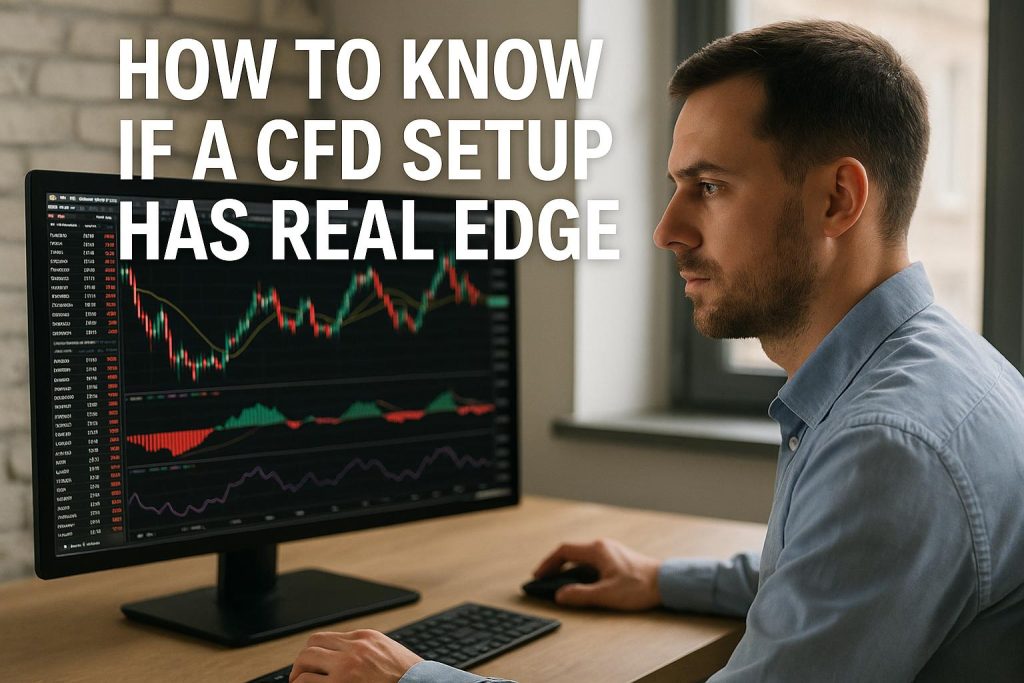
In the intricate and competitive realm of financial trading, possessing an edge is synonymous with having a distinct advantage that enhances the prospects of profitability. This principle applies equally to the sphere of trading Contracts for Difference (CFDs). Traders aiming to identify and leverage a genuine edge within a CFD setup must engage in rigorous analyses, scrutinizing a multitude of elements that influence potential profitability.
A thorough evaluation of the trading strategy forms the foundation of determining if a CFD setup truly possesses an edge. This entails delving into historical performance data to gauge the strategy’s consistent success in outperforming the broader market over an extended duration. In such analyses, traders often consider a variety of metrics including, but not limited to, win/loss ratios, levels of drawdown, and overall profitability. By systematically assessing these factors, traders can ascertain the robustness and credibility of their trading strategies.
Backtesting constitutes a critical process in which trading strategies are assessed against historical data. This enables traders to simulate past market conditions, thus evaluating the effectiveness of their strategies. Using a sufficiently large dataset is paramount to ensuring the statistical significance of the results obtained from backtesting. Traders must exercise caution against over-optimizing strategies to fit historical data, as such practices may not necessarily lead to similar results in future market contexts. This step is integral for validating whether a strategy possesses a sustainable edge.
The financial landscape is inherently dynamic, being influenced by a confluence of economic, political, and social factors. Consequently, a CFD setup with a genuine edge must demonstrate adaptability across varying market conditions. This adaptability ensures sustained profitability, even amid fluctuations such as heightened volatility or shifts in economic indicators. A robust understanding of market conditions is therefore crucial in affirming the credibility of a trading strategy.
Incorporating sound risk management principles is indispensable for any effective CFD trading strategy. Key aspects of risk management include establishing appropriate stop-loss levels, determining optimal position sizing, and evaluating risk/reward ratios. A setup with a real edge will not only aim to maximize returns but also prioritize the safeguarding of capital. This balance between risk mitigation and profit maximization is central to sustaining a competitive advantage in CFD trading.
Successful CFD setups often integrate both technical and fundamental analysis. Technical analysis involves the study of chart patterns and indicators to predict potential price movements, while fundamental analysis involves examining economic data and news events that could influence asset prices. By fusing these analytical approaches, traders heighten their probability of discerning setups that possess a legitimate edge, enabling informed decision-making.
Sustaining an edge in CFD trading necessitates consistent learning and adaptation. Given the evolving dynamics of the market, it is crucial that traders remain agile, regularly updating their strategies to align with new market trends, technological advancements, and economic developments. Staying informed and open to strategically adapting one’s approach based on new data and insights is intrinsic to maintaining a competitive edge.
Incorporating cutting-edge technology and sophisticated trading tools can be instrumental in carving out a real edge in CFD trading. The deployment of automated trading systems, advanced data analysis software, and algorithmic strategies can significantly enhance a trader’s capability to identify and capitalize on profitable opportunities. Leveraging these technological resources allows for more efficient and precise trading operations.
Identifying and sustaining a CFD trading setup with a real edge is a multi-faceted endeavor, demanding meticulous analyses encompassing backtesting, risk management, along with the integration of both technical and fundamental analyses. It is vital to acknowledge that establishing an edge is not a singular achievement but rather an ongoing process characterized by continuous adaptation and learning. Embracing technological advancements and remaining abreast of current market trends further consolidates a trader’s competitive advantage in the ever-evolving landscape of CFD trading.