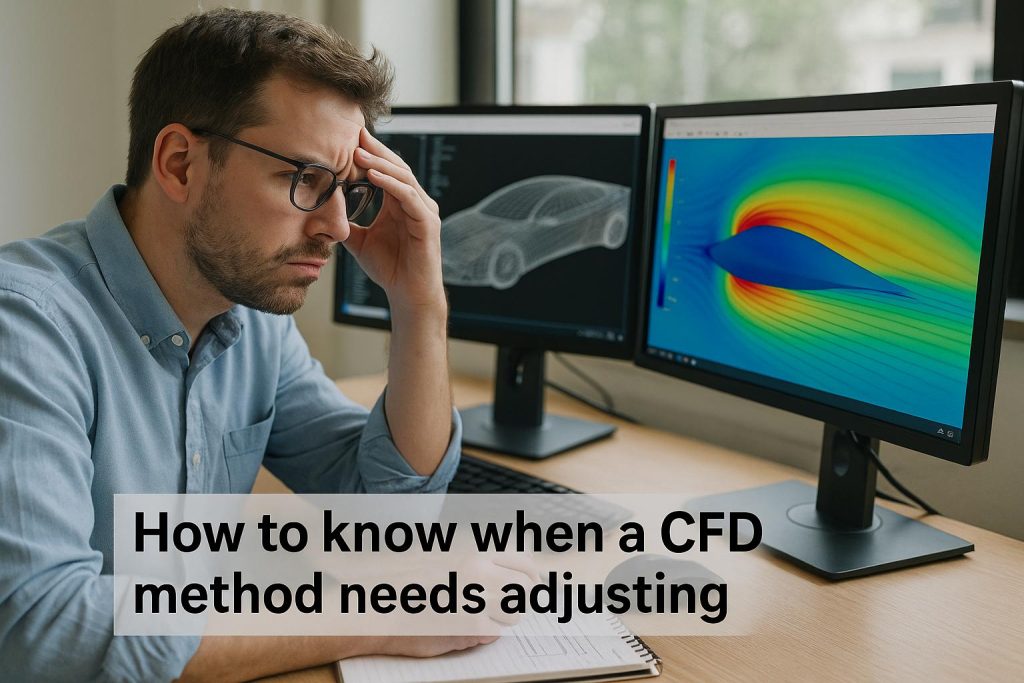
Computational Fluid Dynamics (CFD) is a pivotal tool in fluid mechanics, enabling the simulation and analysis of fluid flow and heat transfer. This process involves using numerical analysis and algorithms to address and solve problems regarding fluid flows. Throughout various industries, including aerospace, automotive, and climate modeling, CFD is utilized to predict how fluids will behave under a range of conditions. However, as with any computational model, there are scenarios where the CFD methods employed may require adjustments. These adjustments are often aimed at improving the accuracy of the simulations or reducing the computational cost.
One of the fundamental indications that a CFD method may need adjustments is when the results do not align adequately with experimental data or theoretical predictions. Ensuring accuracy is vital, as incorrect data could lead to flawed conclusions and potential repercussions in real-world applications. Validation studies, which involve comparing CFD outputs with known benchmarks or experimental findings, are crucial. If the discrepancies consistently exceed acceptable ranges, it is essential to reevaluate the model parameters. Parameters such as boundary conditions, fluid properties, and initial conditions must be scrutinized. Additionally, the meshing strategy or physical models, including turbulence or heat transfer models, may need refinement.
Meshing, in particular, plays a critical role in the accuracy of the results. A finer mesh may capture more details of the flow but come at a higher computational cost. Conversely, a coarser mesh may risk losing essential data. Thus, striking the right balance is key. Regular checks and updates to the models based on new experiments and literature are also indispensable in maintaining accuracy.
Numerical instabilities occur when there are oscillations, divergence, or unexpected residual behavior within the CFD simulation. These instabilities can point to inadequacies in the numerical scheme or grid resolution. This is typically reflected in erratic variations that do not correspond to physical reality. Addressing these issues may require refining the mesh to ensure a more detailed representation of the physical domain.
Adopting a different solver scheme can also be an effective approach. The choice of solver can have a profound impact on the robustness of the simulation. Some solvers are specifically designed to handle certain types of equations or conditions more effectively. Adjusting numerical relaxation parameters can also mitigate instabilities by stabilizing the iterative solution process.
Convergence issues arise when a solution takes too long to stabilize or fails to converge within a limited number of iterations. This can waste computational resources and delay project timelines. A variety of factors can contribute to convergence issues, including the selection of inappropriate initial conditions, boundary conditions, or the presence of high aspect ratio meshes.
To overcome these obstacles, it may be necessary to modify these aspects. Implementing under-relaxation techniques, a process of gradually adjusting the solution variables, can help in achieving better convergence. Alternative strategies might include simplifying the physical models or employing more advanced solution algorithms that are designed to expedite convergence.
In some scenarios, the necessity for adjustments is driven by practical considerations, such as reducing computational costs. If a simulation demands excessive computational resources or time, evaluating certain aspects of the model can lead to more efficient simulations without compromising accuracy.
The mesh density is a prime candidate for optimization. While a denser mesh may lead to more accurate results, it can significantly increase the computational load. Alternatively, employing a coarser mesh with adaptive mesh refinement techniques in critical areas can optimize resource consumption. Additionally, the choice of solver used in the simulation plays a critical role. Some solvers are more computationally efficient for specific types of simulations.
Similarly, time-stepping methods can significantly impact computational costs. Fixed time steps can be replaced with adaptive time-stepping methods that adjust based on the simulation’s demands, potentially leading to time savings. Implementing parallel computing techniques and optimizing computational resources based on the simulation’s requirements can also result in considerable efficiencies.
Mesh independence is a crucial consideration for obtaining reliable CFD results. It involves ensuring that the simulation results are not unduly influenced by the mesh design. If small changes in the mesh lead to substantial variations in results, this indicates a requirement for further mesh refinement or employing an alternative meshing approach.
Mesh sensitivity studies are recommended to determine the optimal mesh setup. These studies involve solving simulations with varied mesh configurations and comparing the outcomes. The objective is to achieve a point where further mesh refinement results in negligible changes to the solution, indicating mesh independence. This ensures that the solution is more robust and closely reflective of the real phenomena being simulated.
Recognizing when adjustments in a CFD method are required is vital for enhancing the reliability and utility of simulations. Attention to result accuracy, numerical stability, convergence, computational efficiency, and mesh dependence is critical in guiding necessary modifications. Understanding the intricacies of CFD requires a comprehensive approach. Resources such as textbooks and research papers can provide deeper insights into specific issues and detailed solutions, offering theoretical and practical guidance.
In practice, collaborating with experienced CFD analysts or participating in dedicated CFD forums and communities can be invaluable. These platforms provide opportunities for professionals to share insights, troubleshoot common problems, and enhance their CFD methodologies through collaborative learning and innovation. Engaging with the CFD community also fosters a dynamic environment where evolving challenges and novel solutions can be brought to light, contributing to the continuous advancement of the field.